Reference Library
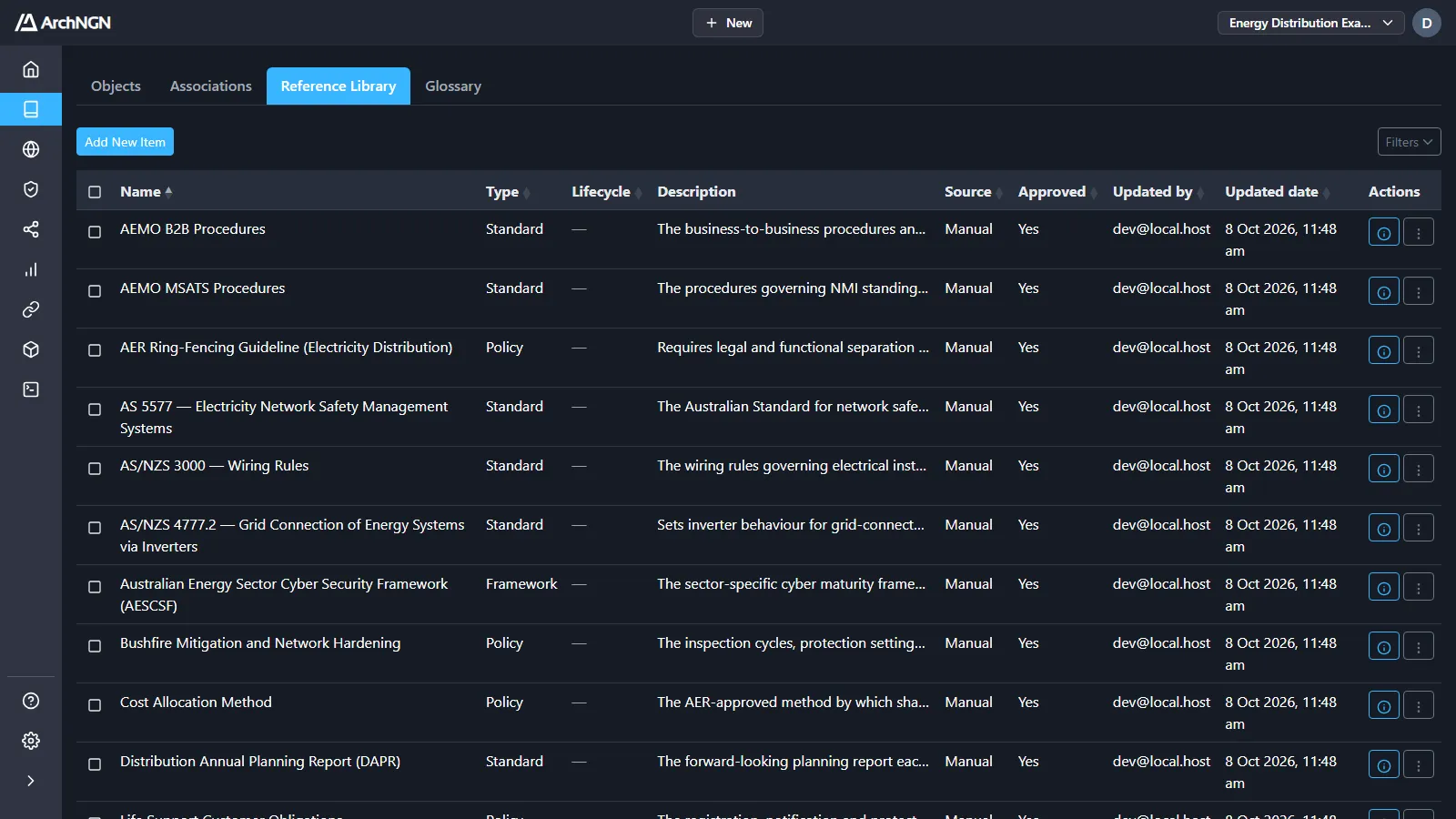
The Reference Library holds the guidance that governs your designs: policies, standards, frameworks, patterns, blueprints and decisions. Design reviews, design checks and coding agents read it, so a standard written here travels into delivery.
Open it from Repository → Reference Library.
What it holds
Section titled “What it holds”| Type | What it is |
|---|---|
| Policy | A rule or intent that must be followed, such as a data privacy policy. |
| Standard | A precise requirement or an approved technology, such as AS/NZS 4777.2 or PostgreSQL 16. |
| Framework | A control from a compliance regime, usually added when a framework is enabled. |
| Pattern | A reusable solution to a recurring problem, such as Network Model as a Single Source of Truth. |
| Blueprint | A reference design or target architecture. |
| Decision | A recorded architectural choice and its reasoning. |
Each item has a name, type, description, Lifecycle (Invest, Tolerate, Migrate or Eliminate), source and Approved state, with who last updated it and when.
Work with items
Section titled “Work with items”- Add New Item, or + New → Reference Library: add an item, set its type, lifecycle and description, and mark it approved once it is ratified.
- Attach the source: upload the document behind a policy, standard or decision, so the full text travels with it.
- Filters: narrow by type, source or approval state, or search by name.
- Approved: separates ratified guidance from drafts. The Explorer’s Context view colours guidance by whether it is endorsed.
Where items come from
Section titled “Where items come from”- By hand, as standards and decisions are ratified.
- Frameworks: enabling a framework adds its controls here as guidance. Disabling it removes them.
- Custom policy packs: publishing a custom pack adds each approved policy here. Items here can also be the sources a pack is drafted from.
- Document connectors: SharePoint and cloud storage connectors record each formally defined policy, standard or decision they find.
- Workstreams: a design that departs from established guidance can propose a decision for review.
Why it matters
Section titled “Why it matters”The more of your guidance is here, and approved, the more a design review, a design check or a coding agent can hold a change to. Where a standard records its intent, rationale and consequences, those reach pipelines and agents with the rule. See REST API.
Related
Section titled “Related”- Frameworks and Custom policies: packs that add guidance here.
- Lifecycle Radar: guidance and technology placed by lifecycle.
- Metamodel: the schema for objects. Guidance is kept here, not as an object category.